Einspruch Lecture: Medicine on Trial: Nuremberg and the Ramifications for Modern Research Ethics
Einspruch Lecture: Medicine and Morality: The Role of Physicians during the Holocaust
The active participation of the medical community – those who took an oath to “first, do no harm,” – in the labeling, persecution, and mass murder of millions of those deemed unfit during the Holocaust, represents one of the darkest periods not only in the history of medicine, but in the history of humankind. This lecture will examine the power and privilege of medicine and the ways in which the core ethical values of the profession can be manipulated. We will also discuss how to use the lessons of medicine, ethics and the Holocaust to foster humanism and moral competency in healthcare.
Transcending Boundaries: An International Holocaust Remembrance Day Event
The lessons of the Holocaust transcend boundaries. They are international, interfaith, inter-professional, and intergenerational. Join our internationally renowned speakers to explore the importance of incorporating the lessons of the Holocaust into the future of education to promote ethical practice in all aspects of society.
This lecture was presented in Krakow on May 7, 2019, as part of the "Medicine Behind Barbed Wire" conference co-sponsored by MIMEH. The conference was part of a larger project, "Medical Review: Auschwitz," which aims to translate journals published after WWII detailing the physical and mental after-effects of the Holocaust on victims of Nazi medicine into multiple languages.
This lecture was presented in Krakow on May 7, 2019, as part of the "Medicine Behind Barbed Wire" conference co-sponsored by MIMEH. The conference was part of a larger project, "Medical Review: Auschwitz," which aims to translate journals published after WWII detailing the physical and mental after-effects of the Holocaust on victims of Nazi medicine into multiple languages.
This lecture was presented in Krakow on May 7, 2019, as part of the "Medicine Behind Barbed Wire" conference co-sponsored by MIMEH. The conference was part of a larger project, "Medical Review: Auschwitz," which aims to translate journals published after WWII detailing the physical and mental after-effects of the Holocaust on victims of Nazi medicine into multiple languages.
This lecture was presented in Krakow on May 7, 2019, as part of the "Medicine Behind Barbed Wire" conference co-sponsored by MIMEH. The conference was part of a larger project, "Medical Review: Auschwitz," which aims to translate journals published after WW II detailing the physical and mental after-effects of the Holocaust on victims of Nazi medicine into multiple langauges.
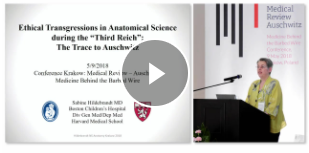
Ethical Transgressions in Anatomical Science during the "Third Reich": The Trace to Auschwitz
This lecture was presented in Krakow on May 9, 2018, as part of the "Medicine Behind Barbed Wire" conference co-sponsored by MIMEH. The conference was part of a larger project, "Medical Review: Auschwitz," which aims to translate journals published after World War II detailing the physical and mental after-effects of the Holocaust on victims of Nazi Medicine into multiple languages.
The Ethical Implications of Nazi Medicine for Current Medical Practice, Healthcare Policy and Human Rights Endeavors
This lecture was presented in Krakow on May 9, 2018, as part of the "Medicine Behind Barbed Wire" conference co-sponsored by MIMEH. The conference was part of a larger project, "Medical Review: Auschwitz," which aims to translate journals published after World War II detailing the physical and mental after-effects of the Holocaust on victims of Nazi Medicine into multiple languages.
How Healers Became Killers: Nazi Doctors and Modern Medical Ethics
This Grand Rounds lecture was presented by Dr. Matthew Wynia and Dr. Patricia Heberer-Rice at the University of Colorado Anschutz Medical Campus as part of the 2018 Holocaust, Genocide, and Contemporary Bioethics program co-sponsored by MIMEH.
Stories from the World of Genocide: from the Holocaust to Life as a 21st Century Refugee
On April 10, 2018, a panel discussion was held at the University of Colorado Anschutz Medical Campus as part of the annual Holocaust, Genocide, and Contemporary Bioethics program co-sponsored by MIMEH. The participants included two Holocaust survivors and two adolescent refugees who discussed their experiences.
The Maimonides Institute for Medicine, Ethics and the Holocaust brought together internationally acclaimed scholars and practitioners for a presentation and panel discussion regarding the relevance of bioethics and the Holocaust for modern medical practice, health law, public policy, and human rights efforts. The panel reflected upon what we have learned in the 70 years since the Doctors' Trial and the publication of the Nuremberg Code and identify areas that still need to be addressed in order to fulfill our obligation to those who lost their lives at the hands of Nazi medicine. Click on the photo to view part four of four.
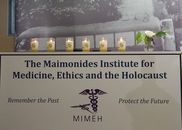
Click on the photo to view the 2017 International Holocaust Remembrance Day Ceremony broadcast from Misericordia University and live-streamed on the United States Holocaust Memorial Museum's website.
Health Care Ethics, Humanities and Social Justice Webinar Series
This webinar series was produced by the Geisinger Commonwealth School of Medicine in conjunction with Misericordia University, with support from the National Endowment for the Humanities.
This webinar series was made possible in part by the National Endowment for
the Humanities CARES grant, "Humanities in the time of COVID-19: Fostering Community Dialogue" Award Number: AH-274885-20. Any views, findings, conclusions, or recommendations expressed in this (article, book, exhibition, film, program, database, report, Web resource), do not necessarily represent those of the National Endowment for the Humanities.
The Nuremberg Doctors’ Trial, arguably the defining moment in modern bioethics, was a direct response to the scientific and medical communities’ participation in the Holocaust. As the only example of medically sanctioned genocide, the Holocaust can provide critical lessons regarding the importance of valuing basic ethical principles ahead of the potential for scientific progress in the contemporary context of research ethics. How do we balance the need for human subject experimentation as a method for achieving advancements in medicine while still protecting the dignity and rights of the individual?